
How DeepSeek and Huawei Upended AI Infrastructure Economics
For years, NVIDIA’s dominance in artificial intelligence seemed entirely untouchable. That dominance was built on a simple premise: if you wanted to build or run a frontier-class large language model, you had to pay the “NVIDIA tax” and wait in line for their H100, H200, or Blackwell GPUs.
Huawei’s Ascend ecosystem and DeepSeek have shattered that narrative, proving that competitive, trillion-parameter AI can be stood up entirely on non-Western silicon.
The Silicon and Pricing Disruption
The core assumption of the last few years was that competing at the frontier of AI required billions in NVIDIA silicon and U.S. cloud infrastructure. DeepSeek broke that rule.
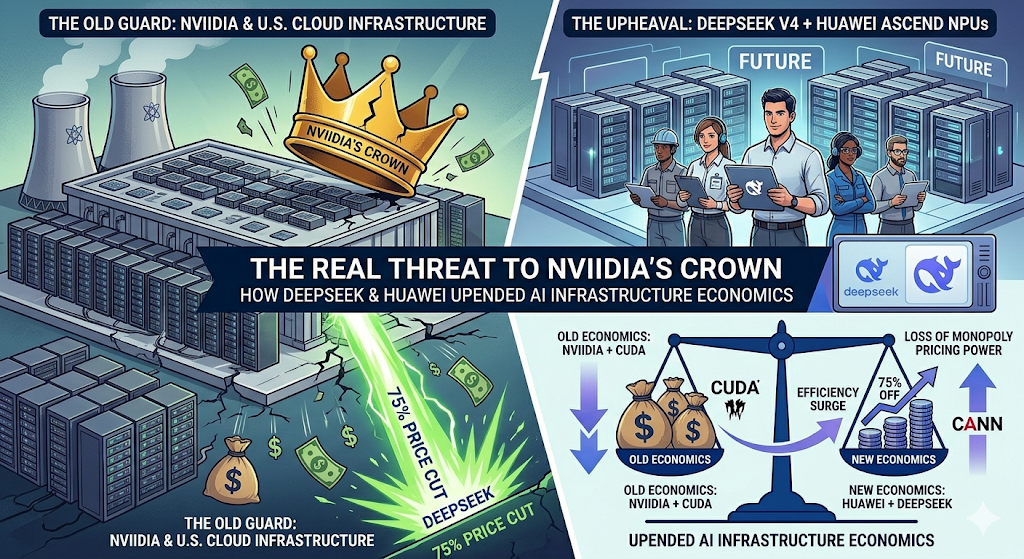
Running natively on Huawei’s Ascend NPUs, DeepSeek’s V4 models have achieved a level of inference efficiency that The Register recently described as “so efficient they’ll run on a toaster.” This hardware independence translates directly to the bottom line. DeepSeek has instituted a permanent 75% price cut on its flagship V4-Pro model — a structural competitive weapon that has driven a massive surge in enterprise procurement.
While analyst tracking from outlets like Latent Space notes that the V4 Pro is no longer the absolute leader in overall raw benchmark scores, its performance remains fiercely competitive with Western models. When a frontier-class model costs a fraction of the price, enterprises that previously couldn’t justify the ROI of advanced AI suddenly can. That is why it is rocketing up enterprise spend charts, emerging as a top trending tool on enterprise spend trackers like Ramp.
Moving Past the “Export-Compliant” Gimmick
When Washington cracked down on advanced chip exports, NVIDIA attempted to preserve its massive Chinese footprint by shipping specialized, stripped-down “export-compliant” GPUs like the H20. But these compromised chips left a performance void — one that local tech giants like Alibaba, Tencent, and ByteDance are no longer willing to tolerate.
Enter Huawei’s Ascend 950PR processor, which anchors the newly unveiled Atlas 350 accelerator card. Boasting 1.56 PFLOPS of FP4 compute performance, the 950PR delivers up to 2.87 times the low-precision processing power of NVIDIA’s hobbled H20. Coupled with reports that Huawei’s Ascend 910C was utilized by engineering teams to manage full-parameter post-training for DeepSeek’s V4 Pro, domestic hardware is proving it can sustain brutal, frontier-level workloads.
The market has shifted at breakneck speed. According to data reported by the Financial Times, Huawei expects its AI chip revenue to surge at least 60% this year to $12 billion, driven by secured orders from domestic hyperscalers. Industry trackers from Wccftech and TrendForce indicate this momentum is positioning Huawei to lock down roughly 60% of China’s domestic high-end AI market by the end of the year, aggressively squeezing NVIDIA out of a massive regional footprint.
The CUDA vs. CANN Software War
NVIDIA’s ultimate moat has never actually been its silicon; it has been CUDA — the proprietary software ecosystem that millions of developers use to write GPU-accelerated code. For a decade, switching away from NVIDIA meant completely rewriting your software stack from scratch.
Huawei is attacking this moat directly with CANN (Compute Architecture for Neural Networks). By optimizing DeepSeek V4 natively for CANN from the ground up, Huawei has closed the optimization gap. They are actively lowering migration barriers by designing CANN to seamlessly interface with universal, hardware-agnostic runtime frameworks like vLLM and SGLang.
What This Means for Global Supply Chains
While DeepSeek’s open-weights are released in standard formats that allow Western developers to deploy V4 on standard AWS or Azure NVIDIA clusters, the back-end reality changes the game:
- A Bifurcated Tech Stack: The world is splitting into two distinct AI infrastructure pipelines — a US-led stack built on NVIDIA and CUDA, and a China-aligned stack running on Huawei and CANN.
- The Loss of Monopoly Pricing Power: As Chinese hyperscalers successfully scale frontier models at a fraction of Western inference costs using domestic silicon, it places intense deflationary pressure on the global AI market. NVIDIA may soon find itself forced to compete on price efficiency rather than relying purely on scarcity.
The DeepSeek efficiency story is undeniable proof that the US chip embargo did not starve Chinese AI development — it merely accelerated the birth of a fiercely independent, highly competitive hardware rival.