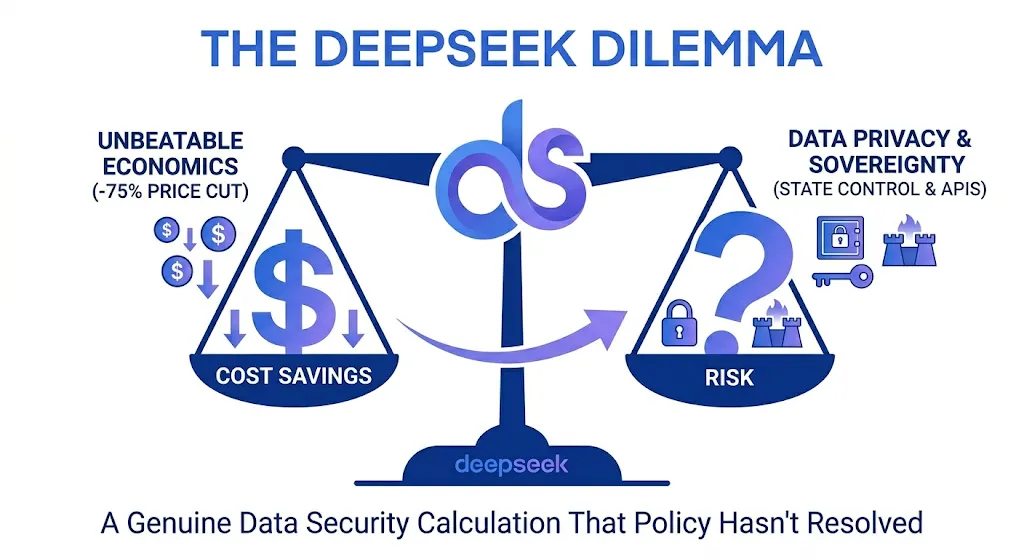
Unbeatable Economics vs. The Enterprise Privacy Vacuum
If you look at Ramp’s current trending enterprise software charts, one name has suddenly eclipsed the usual SaaS heavyweights: DeepSeek.
The Chinese AI lab isn’t just competing on performance; it is fundamentally rewriting the economics of frontier AI. But for Western enterprises, this cost disruption comes with a massive, unresolved catch: a geopolitical and data privacy calculation that no one in Washington has solved for them.
Here is why DeepSeek is impossible to ignore, and why integrating it is a high-stakes gamble.
The Silicon and Pricing Disruption
The core assumption of the last few years was that competing at the frontier of AI required billions in NVIDIA silicon and U.S. cloud infrastructure. DeepSeek broke that rule.
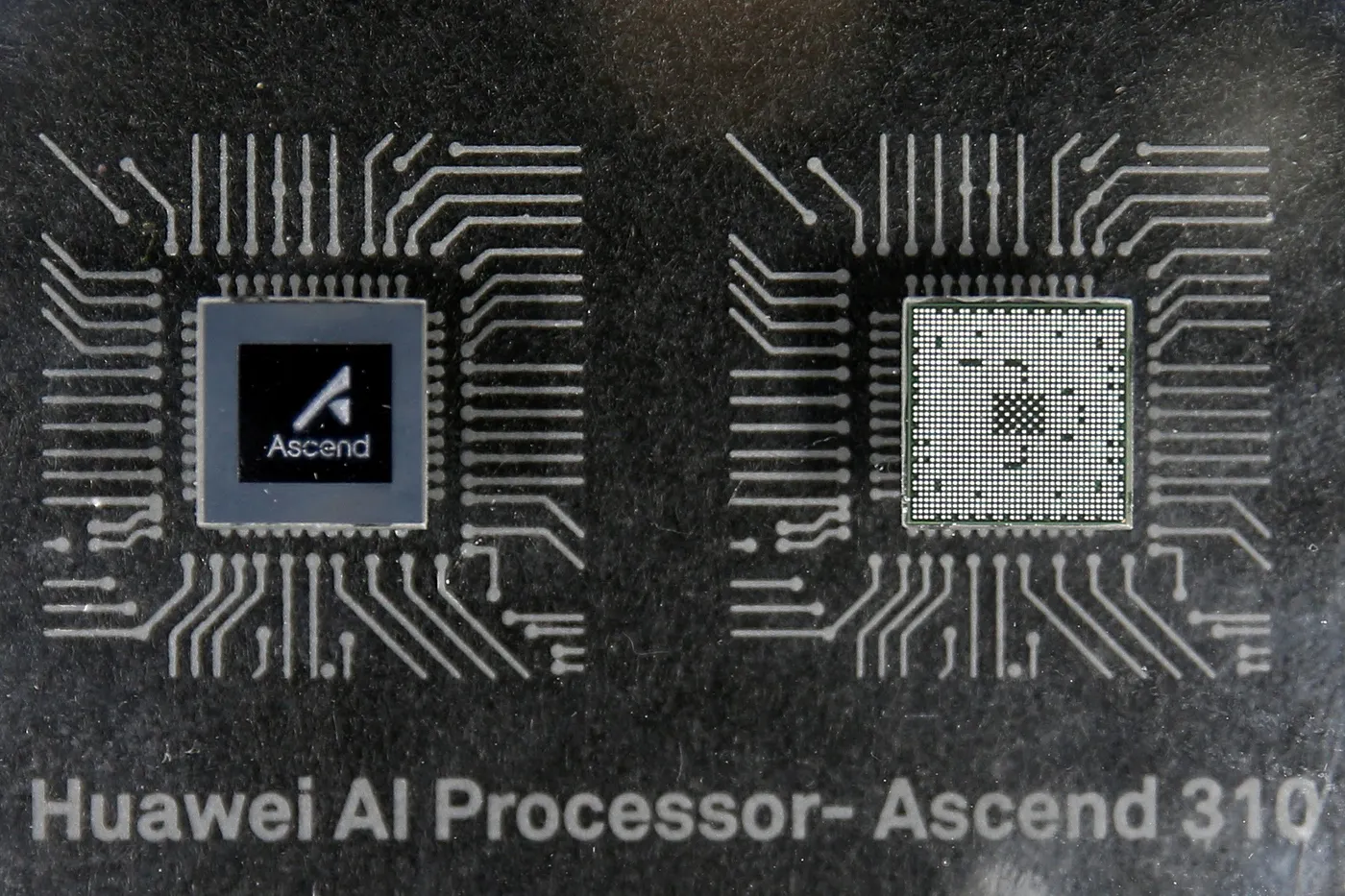
Running natively on Huawei’s Ascend NPUs, DeepSeek’s new V4 models have achieved a level of inference efficiency that The Register recently described as “so efficient they’ll run on a toaster”. This hardware independence translates directly to the bottom line. DeepSeek has instituted a permanent 75% price cut on its flagship V4-Pro model — a structural competitive weapon that has driven a massive surge in enterprise procurement.
While analyst tracking from outlets like Latent Space notes that the V4 Pro is no longer the absolute leader in overall raw benchmark scores, its performance remains fiercely competitive with Western models. When a frontier-class model costs a fraction of the price, enterprises that previously couldn’t justify the ROI of advanced AI suddenly can. That is why it is rocketing up enterprise spend charts.
The Real Threat to NVIDIA’s Crown
For years, NVIDIA’s dominance in artificial intelligence seemed entirely untouchable. That dominance was built on a simple premise: if you wanted to build or run a frontier-class large language model, you had to pay the “NVIDIA tax” and wait in line for their H100, H200, or Blackwell GPUs.
Huawei’s Ascend ecosystem has shattered that narrative, proving that competitive, trillion-parameter AI can be stood up entirely on non-Western silicon.
Moving Past the “Export-Compliant” Gimmick
When Washington cracked down on advanced chip exports, NVIDIA attempted to preserve its massive Chinese footprint by shipping specialized, stripped-down “export-compliant” GPUs like the H20. But these compromised chips left a performance void — one that local tech giants like Alibaba, Tencent, and ByteDance are no longer willing to tolerate.
Enter Huawei’s Ascend 950PR processor, which anchors the newly unveiled Atlas 350 accelerator card. Boasting 1.56 PFLOPS of FP4 compute performance, the 950PR delivers up to 2.87 times the low-precision processing power of NVIDIA’s hobbled H20. Coupled with reports that Huawei’s Ascend 910C was utilized by engineering teams to manage full-parameter post-training for DeepSeek’s V4 Pro, domestic hardware is proving it can sustain brutal, frontier-level workloads.
The market has shifted at breakneck speed. According to data reported by the Financial Times, Huawei expects its AI chip revenue to surge at least 60% this year to $12 billion, driven by secured orders from domestic hyperscalers. Industry trackers from Wccftech and TrendForce indicate this momentum is positioning Huawei to lock down roughly 60% of China’s domestic high-end AI market by the end of the year, aggressively squeezing NVIDIA out of a massive regional footprint.
The CUDA vs. CANN Software War
NVIDIA’s ultimate moat has never actually been its silicon; it has been CUDA — the proprietary software ecosystem that millions of developers use to write GPU-accelerated code. For a decade, switching away from NVIDIA meant completely rewriting your software stack from scratch.
Huawei is attacking this moat directly with CANN (Compute Architecture for Neural Networks). By optimizing DeepSeek V4 natively for CANN from the ground up, Huawei has closed the optimization gap. They are actively lowering migration barriers by designing CANN to seamlessly interface with universal, hardware-agnostic runtime frameworks like vLLM and SGLang.
What This Means for Global Supply Chains
While DeepSeek’s open-weights are released in standard formats that allow Western developers to deploy V4 on standard AWS or Azure NVIDIA clusters, the back-end reality changes the game:
- A Bifurcated Tech Stack: The world is splitting into two distinct AI infrastructure pipelines — a US-led stack built on NVIDIA and CUDA, and a China-aligned stack running on Huawei and CANN.
- The Loss of Monopoly Pricing Power: As Chinese hyperscalers successfully scale frontier models at a fraction of Western inference costs using domestic silicon, it places intense deflationary pressure on the global AI market. NVIDIA may soon find itself forced to compete on price efficiency rather than relying purely on scarcity.
The DeepSeek efficiency story is undeniable proof that the US chip embargo did not starve Chinese AI development — it merely accelerated the birth of a fiercely independent, highly competitive hardware rival.
The Policy Vacuum
Normally, when a foreign technology poses a potential security threat at this scale, enterprises wait for regulatory guidance. Will it be banned? Will it be restricted?
Right now, the answer is no. The U.S. government recently evaluated DeepSeek and officially held off on blacklisting the company.
While that might seem like a green light, it’s actually a burden shift. By choosing not to enact a ban, Washington has signaled that data sovereignty concerns have not yet reached the threshold for policy action. The result is a regulatory vacuum. Enterprises are entirely on their own to navigate the risk of routing proprietary company data, customer IP, and strategic queries through APIs hosted under Chinese jurisdiction.
The Reality of State Control
If the lack of U.S. policy gives a false sense of security, actions within China should dispel it.
Recent reports indicate that Chinese government agencies have begun imposing strict overseas travel restrictions on the tech workers building these very models. This move highlights a critical reality: regardless of how efficient the API is, or how independent the company claims to be, the state is actively tightening its grip on the talent and infrastructure powering these systems.
For Western companies considering deep integration, this complicates the picture. You aren’t just adopting a software tool; you are tethering a piece of your tech stack to an ecosystem where state intervention is a feature, not a bug.
The Bottom Line
DeepSeek is winning on price and efficiency in ways that are mathematically impossible to dismiss. But the savings come with invisible baggage.
Until the policy landscape hardens, enterprises must adopt a zero-trust posture. If you are leveraging DeepSeek to capitalize on the 75% discount, it must be walled off. Sandboxed environments, strict data anonymization, and limiting the model to non-sensitive workloads (like public data processing or boilerplate code generation) are no longer just best practices — they are the only way to play the DeepSeek advantage without betting the company’s data security.
The Playbook: Technical Mitigation Strategies
If the economic upside of DeepSeek (or any external, foreign-hosted model) is too significant to ignore, enterprises must move from a posture of theoretical trust to one of cryptographic and architectural control. You cannot rely on a vendor’s “we don’t train on your data” promise when that vendor operates in a highly scrutinized, state-controlled jurisdiction.
To safely leverage these models, security teams must build a robust proxy layer that sanitizes, isolates, and monitors every packet of data traveling to the API. Here is the technical blueprint for mitigating risk.
1. Pre-API Data Masking and Sanitization
Never send raw data to an external endpoint. The first line of defense is an automated sanitization layer that intercepts prompts before they leave your network.
- Dynamic Redaction: Implement systems that automatically detect and redact Personally Identifiable Information (PII), API keys, and proprietary keywords.
- Tokenization: Replace sensitive internal identifiers with synthetic tokens. For example, replacing a real client name with
<Client_A>before the prompt is sent, and mapping the real name back onto the model’s output locally when the response is returned. This ensures the external model never actually “sees” your sensitive entities.
2. AI Security Gateways and Proxy Layers
Treat external AI models like untrusted third-party contractors. Instead of allowing internal applications to make direct API calls to DeepSeek, route all traffic through an AI Security Gateway or a proxy layer (like Google’s Apigee or specialized AI firewalls).
- Traffic Inspection: A proxy layer filters inputs against prompt injection and policy violations while scanning outputs for data exfiltration.
- Rate Limiting & Anomaly Detection: By centralizing access through a gateway, you can set strict rate limits and trigger immediate alerts if an application suddenly attempts to upload an unusually large payload (a classic sign of data exfiltration).
3. VPC Isolation for Hybrid Architectures
If you are running DeepSeek’s open-weights models (rather than using their API), isolation is entirely within your control.
- Network Segregation: Deploy the model within a private Virtual Private Cloud (VPC) that has strictly controlled ingress and egress rules.
- Air-Gapping: For highly sensitive workloads, the environment hosting the model should have no direct outbound internet access. It should only be accessible via internal load balancers, ensuring that even if the model were somehow compromised, it cannot phone home or leak data to external servers.
4. Controlled Context via RAG
Instead of fine-tuning the model on your proprietary data — which bakes your secrets directly into the model’s weights — use Retrieval-Augmented Generation (RAG).
- Vetted Knowledge Bases: Keep your sensitive data housed internally in secure vector databases.
- Just-in-Time Context: When a query is made, retrieve only the specific snippets of data required to answer the question, append them to the prompt (after masking), and send them to the API. This ensures the model only ever has access to fragmented, ephemeral context rather than your entire corporate corpus.
By implementing these architectural safeguards, organizations can effectively turn external AI endpoints into “dumb” processing engines — extracting the immense value of DeepSeek’s low-cost reasoning capabilities while fundamentally restricting what the model actually knows about the business.