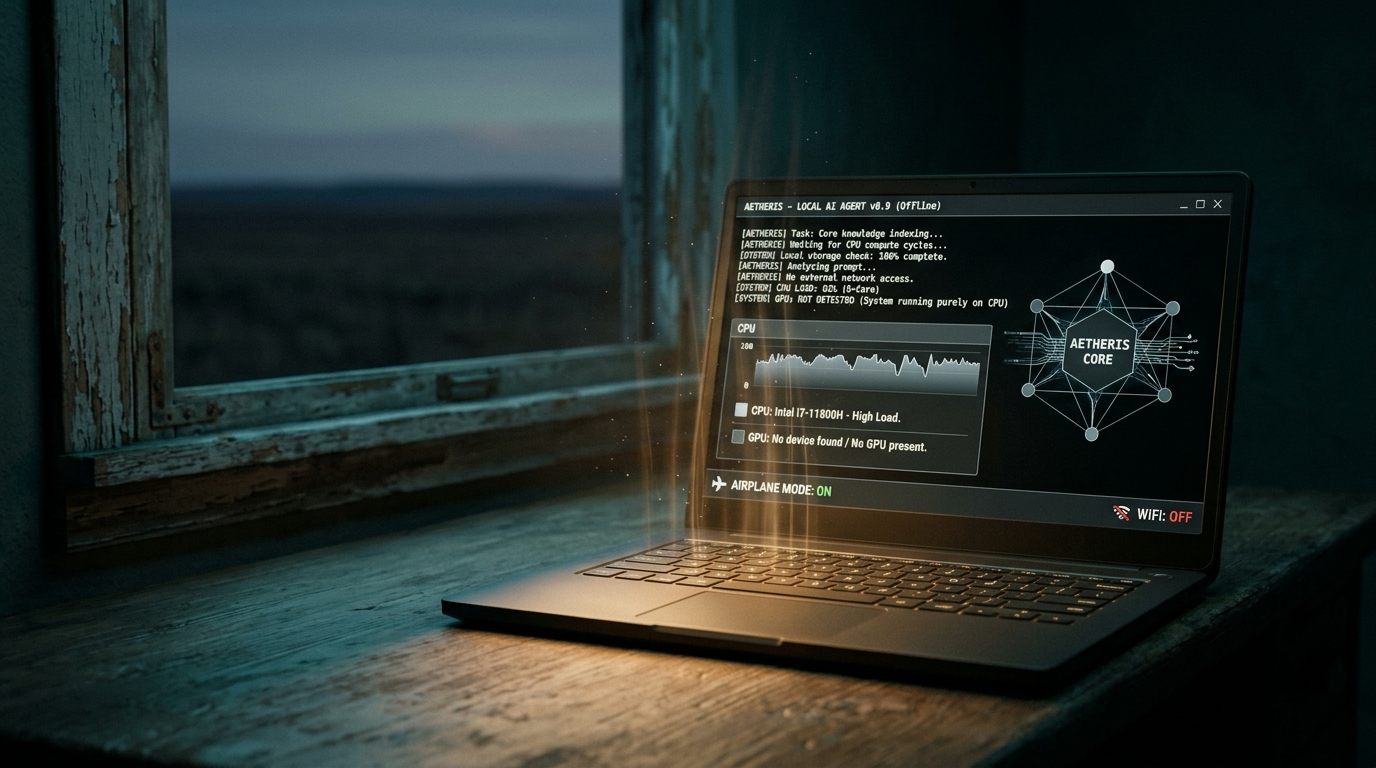
A 284-billion-parameter frontier model now runs on a laptop CPU. No GPU, no data center, no API key. That’s the best news in tech this year, and it’s also the clearest sign that our rules for AI were written for a world that’s already gone.
The project is called llama-modchip, an open-source, Apache-2.0 build on top of llama.cpp. Its author squeezed DeepSeek-V4-Flash (284B total parameters, about 13B active per token) into a 56.56 GiB file using a custom compression format, then ran it on an AMD Ryzen 9 9955HX with 64 GB of DDR5. Prefill runs at about 44 tokens per second. Decode on the CPU alone runs at about 9 to 10.7 tokens per second. That’s reading speed, from a machine you can buy off the shelf.
It’s not a one-off, either. Back in June, a developer ran Google’s Gemma 4 26B at about 5 tokens per second on a 2013-era dual Xeon storage server that cost under $300. He isn’t a C++ programmer. Claude found and fixed the bugs that kept the code from running on chips that old.
Fast and furious
I love this. I run local models on an old Radeon RX 580 in my homelab, and every few months the ceiling on what that box can do moves up without me buying anything. The software keeps getting smarter faster than the hardware gets cheaper. For anyone who builds things, it’s a great time to be alive.
And a little Wild West
Here’s the catch. Almost every strategy for governing AI assumes the powerful models live in big data centers. Export controls target high-end GPUs. Safety policies are enforced at the API. Usage terms work because a company sits between you and the model and can say no.
A frontier-class model on a 64 GB laptop has nobody in the middle. No API to rate-limit, no account to suspend, no GPU to track. Once the weights are out, they’re out.
We’ve seen this movie. The early internet arrived before the law knew what to do with it. Congress didn’t pass Section 230 until 1996, and courts spent the next decade sorting out copyright, privacy and liability after Napster and everything that came after. Some of the rules that came out of that era were good. Some were rushed. Almost all of them came late.
I don’t think the answer is to slam the brakes. Open, local AI is also the best protection we have against a handful of companies owning the whole thing. But “the model lives in a data center” isn’t a safe assumption anymore, and policy built on it is going to age badly.
One honest caveat: the modchip numbers are the author’s own, and squeezing a 284B model that hard costs some quality. Nobody has independently reproduced them yet. The direction is what matters, and the direction is not in doubt.
The internet taught us that the rules eventually catch up to the technology. The lesson worth remembering this time is to start writing them for where the technology is going, not where it was last year. Today that place is your laptop.
Sources
- llama-modchip, GitHub (synchopate), Nov 2026
- Running Gemma 4 26B at 5 tokens/sec on a 13-year-old Xeon with no GPU, Neomind Labs, Jun 2026
- DeepSeek V4 local run guide, Unsloth