
A Deeper Look at Modern Security Gaps
Don’t trash-talk my DMZ
De-Militarized Zones (DMZs) were the go-to for a long time in network security. Think of them as the bouncers at the club door — a necessary first line of defense. And for a while, they did a pretty decent job of keeping the “internet riff-raff” out of the main party (your internal network). The idea was that if a public-facing server in the DMZ (like your website) got hit, the damage would hopefully be contained there.
But, like fashion, technology, and the tactics of those trying to break it, change. What worked well yesterday isn’t always up to snuff today. Let’s dig a bit deeper into why the good old DMZ model is showing its age and often falls short in the face of modern applications and threats.
The “East-West” Traffic Blind Spot: More Than Just a One-Way Street
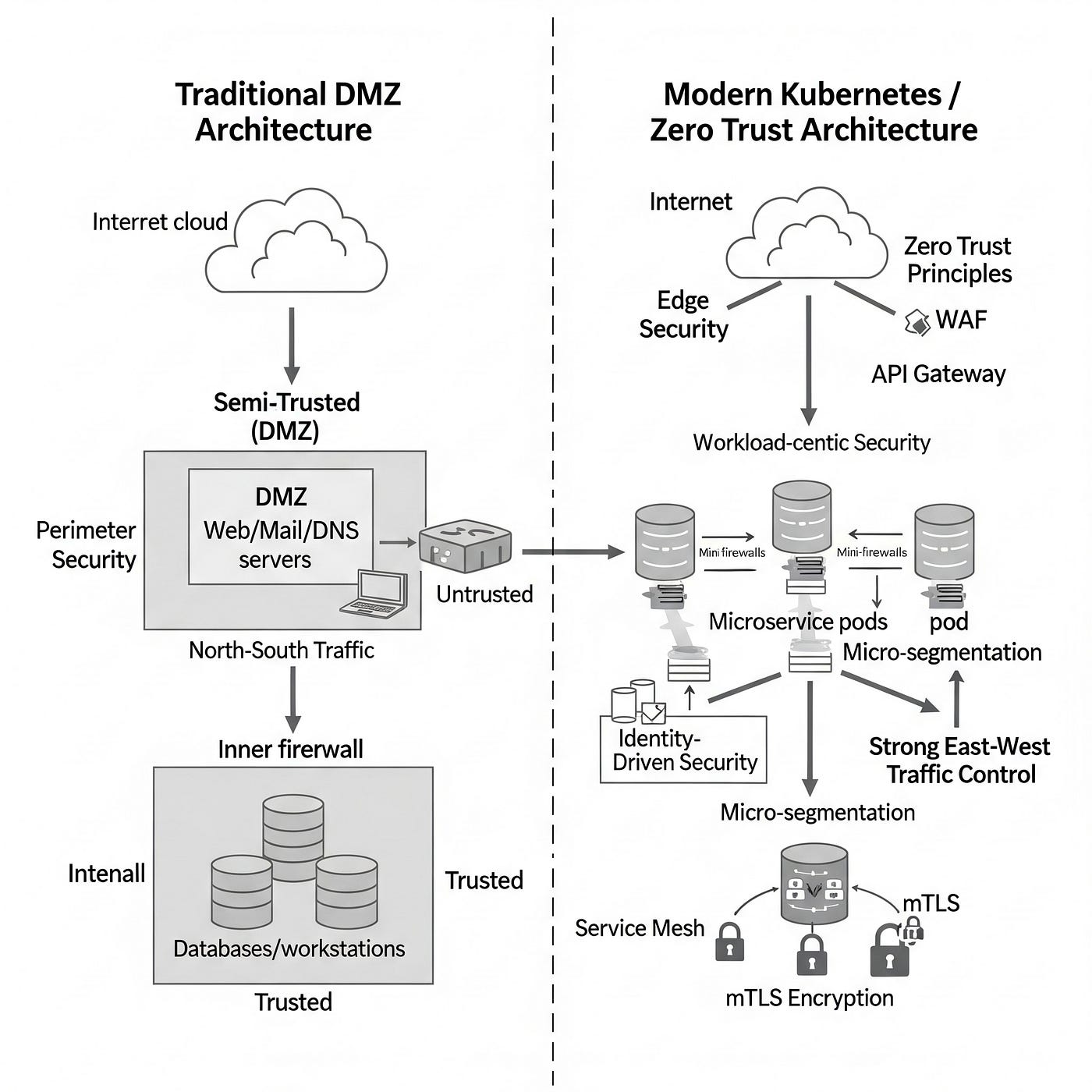
Traditional DMZs are primarily designed to inspect and control “North-South” traffic — that’s data flowing in from the internet to the DMZ, or out from the DMZ to the internet (or sometimes, carefully, to the internal network).
- The Problem: Once an attacker compromises one server within the DMZ, they often find it much easier to move laterally, or “East-West,” to other servers within that same DMZ segment. Imagine a row of houses in a gated community; once you’re past the main gate, hopping fences between backyards might not be that hard if there aren’t individual fences.
- Why it Matters Today: Modern attacks are rarely smash-and-grab. Attackers often land on one less-critical system and then patiently explore, looking for more valuable targets within the network. If your DMZ is a relatively flat, open space internally, you’re making their job easier. Microservices and distributed applications also mean there’s a lot more legitimate East-West communication happening, which can make malicious traffic harder to spot without finer-grained controls.
Rigidity vs. Agility: When Your Security Can’t Keep Pace
DMZ architectures are often built on fairly static network configurations and firewall rulesets. Need to deploy a new service or update an existing one? That often means manual firewall change requests, network reconfigurations, and approval processes.
- The Problem: In today’s world of DevOps, CI/CD pipelines, and applications that need to scale up or down in minutes, this traditional, slower pace of change for security infrastructure is a major bottleneck. It can stifle innovation or, worse, lead to developers finding workarounds that bypass security altogether just to get things done.
- Why it Matters Today: Businesses need to be agile. If your security model can’t adapt quickly to new application deployments, changes in traffic patterns, or evolving business needs, it becomes an inhibitor rather than an enabler.
Modern IT is hybrid and distributed. Security needs to be able to follow the workload and data, wherever it resides, rather than being tied to a fixed network boundary.

Coarse-Grained Control: Missing the Micro-Details
DMZs typically segment networks at a fairly high level — you have the internet, the DMZ, and the internal network. Within the DMZ, all servers might be treated somewhat equally from a network perspective.
- The Problem: This doesn’t offer the granular, application-aware control that modern security demands. You might have a web server, an API gateway, and a database connector all in the DMZ. Should they all be able to talk to each other freely? Probably not. The web server might only need to talk to the API gateway, and the API gateway only to specific backend services.
- Why it Matters Today: With microservices, where applications are broken down into many small, independent services, you need “micro-segmentation.” This means being able to define very specific communication rules for each tiny piece of your application, regardless of what larger network segment it sits in. A DMZ alone usually can’t provide this level of detail.
Micro-segmentation: This means being able to define very specific communication rules for each tiny piece of your application, regardless of what larger network segment it sits in.
The “Trusted” Internal Network: An Outdated Assumption?
A core assumption of the DMZ model is that the internal network is “trusted” and the DMZ is “less trusted.” This binary view is increasingly problematic.
- The Problem: Insider threats (malicious or accidental) are a significant concern. Also, if an attacker does manage to pivot from the DMZ to the internal network (or vice-versa through a compromised internal machine reaching out), the assumption of internal trust can mean fewer security controls are in place to detect or stop them.
- Why it Matters Today: Zero Trust security models are gaining traction for a reason. The principle is “never trust, always verify,” meaning you don’t automatically grant trust based on network location. Every user, device, and application should be authenticated and authorized before accessing resources, regardless of whether they’re “inside” or “outside.”
The principle is “never trust, always verify,” meaning you don’t automatically grant trust based on network location.
Cloud, Hybrid, and Microservices: The Perimeter is Disappearing
The traditional DMZ relies heavily on the concept of a defensible network perimeter. But what happens when your applications and data are spread across on-premises data centers, multiple public clouds, and edge locations?
- The Problem: The “perimeter” as we knew it is dissolving. Trying to stretch a traditional DMZ concept across these distributed environments is often complex, inefficient, and ineffective. Each cloud provider has its own security tools and paradigms, and forcing them into an old DMZ model can negate many of their benefits.
- Why it Matters Today: Modern IT is hybrid and distributed. Security needs to be able to follow the workload and data, wherever it resides, rather than being tied to a fixed network boundary.
Operational Overhead: Too Many Moving Parts
Managing traditional DMZs, with their associated firewalls, routers, and distinct network segments, can be operationally intensive.
- The Problem: Keeping firewall rulesets clean, updated, and accurate is a constant battle. Troubleshooting connectivity issues through multiple network hops can be a nightmare. As the number of services in the DMZ grows, so does the complexity of managing it all securely.
- Why it Matters Today: Security teams are often stretched thin. Solutions that add a significant operational burden without a proportional increase in effective security are hard to justify. Automation and centralized management are key, and traditional DMZ setups often lack these in a holistic way.
So, What’s the Takeaway?
The DMZ isn’t “bad” — it was a product of its time and served a valuable purpose. However, for many modern application environments, it’s like using a map from the 1990s to navigate a city in 2025. The landscape has changed too much.
The limitations we’ve discussed are why there’s such a strong push towards security models that are more integrated with applications, more dynamic, and more granular — things that platforms like Kubernetes and OpenShift, with their focus on container security, network policies, and service meshes, are designed to provide. It’s about building security in, not just bolting it on around the edges.